
Working Hours
Daily from 10:00 AM to 12:00 AM
Working Hours
Send Us a Message
Call Us
Visit Us
Can a Herniated Disc Be Treated Without Surgery?
Discover practical rehabilitation insights from our specialists.
October 5, 2026
Can a herniated disc be treated without surgery? Learn about physical therapy, exercises, spinal traction, warning signs, surgery indications, and Miami Center branches.
Yes, many herniated disc cases can be treated without surgery, especially when the symptoms are mild to moderate and are not accompanied by progressive neurological weakness or other warning signs. The appropriate treatment depends on the location of the herniated disc, its severity, the symptoms, the clinical examination, and the impact of the condition on movement and daily activities.
In suitable cases, treatment usually begins with conservative care, such as activity modification, physical therapy, therapeutic exercises, manual therapy, and selected supportive treatment techniques. However, there is no single treatment plan that is suitable for every patient. A doctor or qualified specialist should evaluate the condition before starting any treatment program.
Miami Physical Therapy and Rehabilitation Center provides physical therapy programs for lumbar and cervical disc herniation. The treatment plan is determined after assessing the patient’s condition and reviewing the diagnosis. You can explore the center’s physical therapy and rehabilitation services or book an assessment appointment.
Between the vertebrae of the spine are discs that act as cushions, helping absorb shock and allowing the back and neck to move. A herniated disc occurs when part of a disc bulges or shifts out of position, which may irritate or compress a nearby nerve.
A herniated disc can occur in the lower back, which is the most common location, or in the neck. Symptoms vary from one person to another. Some people may experience only localized pain, while others may develop pain extending into the leg or arm when a nerve is affected.
Symptoms depend on the location of the affected disc and the nerves that may be compressed. Possible symptoms include:
Pain in the lower back or neck.
Pain extending into the leg, which may be associated with sciatica in some lumbar disc cases.
Pain extending into the shoulder or arm in some cervical disc cases.
Numbness or tingling in the leg, foot, arm, or hand.
Weakness in certain muscles.
Difficulty walking, moving, or performing certain daily activities.
Pain that increases with certain movements, coughing, or sneezing in some cases.
You can learn more about herniated disc symptoms, or read about cervical disc herniation symptoms.
In many cases, yes. Symptoms may gradually improve with conservative treatment and by following the specialist’s instructions, especially when there is no evidence of neurological deterioration or severe nerve compression. The goal of non-surgical treatment is not only to reduce pain, but also to improve movement, restore strength, and help the patient return safely to daily activities.
Treatment outcomes vary from one patient to another. Some patients may respond within a relatively short period, while others may require longer follow-up or a reassessment of the treatment plan. The presence of a herniated disc on imaging does not automatically mean that surgery is necessary. The decision depends on the symptoms, clinical examination, neurological function, and impact on daily activities.
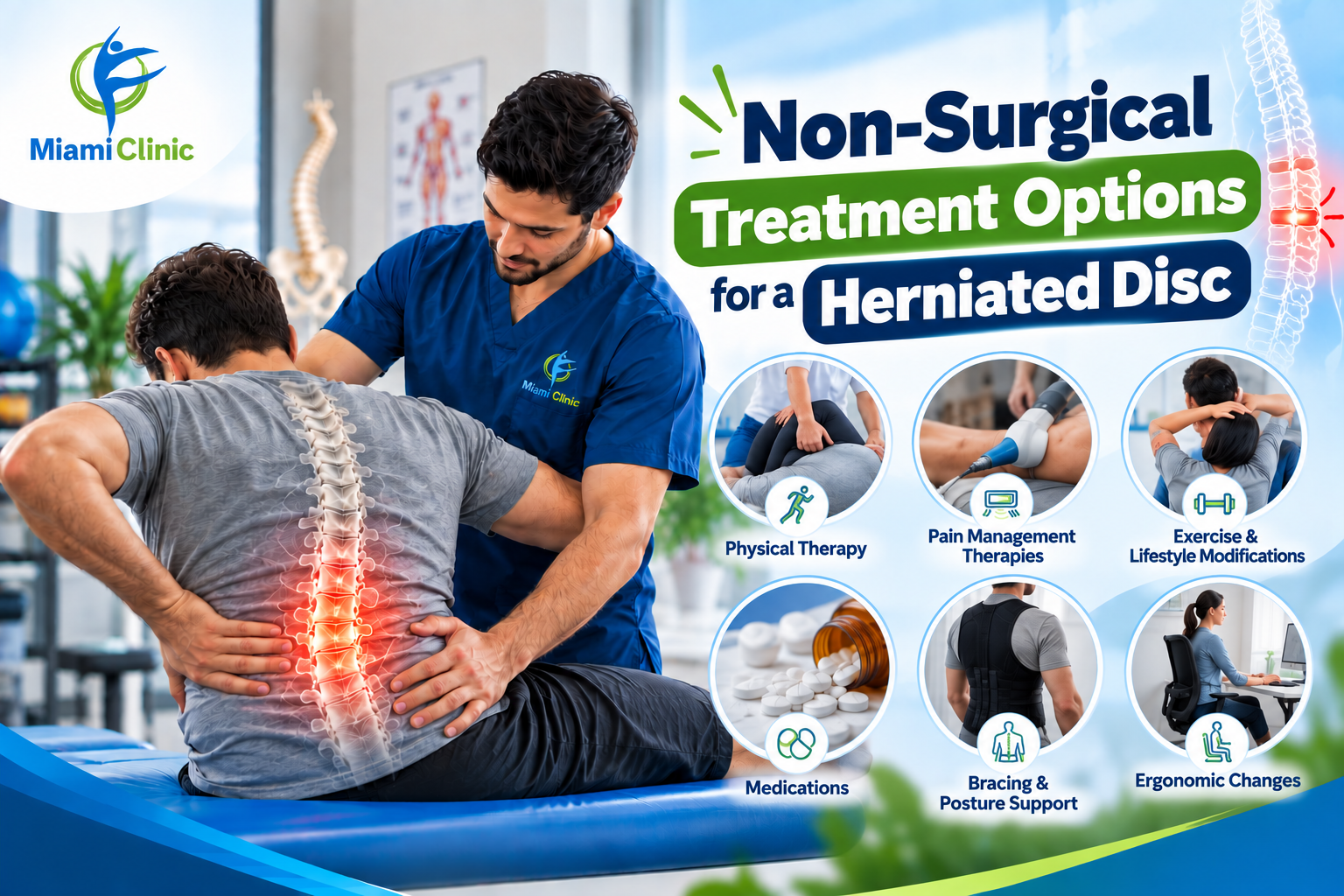
An appropriate treatment plan begins by understanding the symptoms, reviewing the medical history, and assessing movement, muscle strength, sensation, and reflexes when necessary. This helps identify the possible source of pain and determine whether the patient is suitable for physical therapy or needs further medical evaluation.
Miami Physical Therapy Center’s treatment approach is based on assessing each patient and creating a program that matches their goals, with ongoing follow-up and progress monitoring.
A physical therapist may prescribe exercises that are suitable for the patient’s condition and stage of symptoms. These exercises may aim to:
Gradually improve spinal movement.
Strengthen the core and muscles that support the back.
Improve flexibility and reduce stiffness.
Restore the ability to move and perform daily activities.
Teach safer ways to move, lift, sit, and perform everyday tasks.
Random exercises found online are not recommended, because certain movements may worsen symptoms in some patients. Stop the exercise and consult a specialist if new weakness appears or if numbness or pain increases significantly.
A specialist may use manual therapy techniques to improve joint and soft-tissue movement, reduce stiffness, and help relieve pain as part of an integrated program. Manual therapy is not a substitute for assessment or therapeutic exercises; it may be used as one component of the plan when appropriate for the patient.
Learn more about manual therapy among the center’s services.
Spinal traction is one of the techniques that may help reduce pressure on the vertebrae and improve spinal movement in suitable cases. Miami Physical Therapy Center states that it has a three-dimensional spinal traction device. The device is used after assessing the patient and reviewing the diagnosis because traction is not suitable for everyone.
For more information, read Benefits of Spinal Traction for a Herniated Disc to learn more about suitable cases, contraindications, and warning signs.
Depending on the assessment, the specialist may add selected supportive techniques to the treatment program, such as:
Electrotherapy to stimulate nerves and muscles and help relieve pain.
Ultrasound therapy to support tissue flexibility in suitable cases.
Low-level laser therapy or TECAR therapy as part of the treatment plan.
Cryotherapy to help calm pain and swelling in certain cases.
These techniques should not be used separately from assessment and therapeutic exercises, and they are not suitable for every patient. You can explore the available treatment services.
Organizing daily activities may help reduce symptom irritation. Depending on the condition, a specialist may recommend:
Avoiding complete bed rest for long periods unless medically advised.
Returning to movement gradually instead of avoiding movement completely.
Avoiding heavy lifting and sudden movements during periods of acute pain.
Changing sitting positions regularly and avoiding prolonged sitting.
Using safe techniques when bending or lifting objects.
Following the exercises and home instructions prescribed by the physical therapist.
The need for surgery cannot be determined based on imaging alone. A doctor may discuss surgery when pain is severe and persistent despite an appropriate course of conservative treatment, when there are signs of significant nerve compression, when weakness is progressing, or when movement and daily function are clearly affected.
Surgery may be an urgent option in some cases associated with serious neurological symptoms. Therefore, patients should be evaluated by a specialist if unusual or worsening symptoms appear.
Seek urgent medical evaluation if you experience any of the following:
Loss of bladder or bowel control.
New or increasing difficulty urinating.
Numbness in the inner thighs or around the groin area.
Severe or progressive weakness in the leg or arm.
Increasing difficulty walking or loss of balance.
Severe pain after an injury or accident.
Pain accompanied by fever, unexplained weight loss, or general deterioration.
These symptoms do not necessarily confirm a serious condition, but they require prompt assessment. Do not rely only on home treatment or delay medical evaluation.
It is important to distinguish between improvement in symptoms and changes in the appearance of the disc on imaging. Physical therapy may help reduce pain, improve movement, restore strength, and improve the ability to perform daily activities. In some cases, symptoms gradually improve over time with conservative treatment.
However, no single outcome can be guaranteed for every patient. It is not appropriate to promise that physical therapy will permanently remove a herniated disc or prevent surgery in all cases. The goal is to choose the safest and most suitable treatment based on the examination, diagnosis, and response to the program.
Miami Physical Therapy Center has several branches where patients can book an assessment and physical therapy services. Three branches are located in Alexandria, in addition to branches in Dokki and Sheikh Zayed.
Address: 248 Gamal Abdel Nasser Street, after Gehan Roundabout, Alexandria.
Contact numbers:
03 5571448 - 01552541151
For details, visit the Miami Branch page or open Google Maps directions.
Address published on the website: 72 Moharram Bek Street, Moharram Bek, Alexandria.
Contact numbers:
033933060 - 01501010192
You can view the Moharram Bek Branch details or use the Google Maps directions link. It is recommended to contact the center before visiting to confirm the detailed address and available appointment times.
Address: 21 El-Geish Road (the Corniche), next to Abdel Moneim Gaber Theater, near El-Shatby signal, Alexandria.
Contact number: 01501046466
For more information, visit the Kampeshzar Branch page or open Google Maps directions.
Address: 70 Mossadak Street, Dokki, opposite Vodafone.
Contact numbers:
01501010194
0233362623
You can visit the Dokki Branch page or open Google Maps directions.
Address: Al Saraya Mall, next to Saudi Market, near Arkan.
Contact number:
01514115144
For more details, visit the Sheikh Zayed Branch page or open Google Maps directions.
To view all branches, visit the Miami Physical Therapy Center branches page.
According to the official website, Miami Physical Therapy Center is open every day from 10:00 AM to 12:00 AM. It is recommended to call the center before visiting to confirm the assessment schedule and availability of the appropriate service.
You can book through the Contact Us page, or contact the center via WhatsApp.
General phone number: 0233362623
Email: Miamislimmingcenter@gmail.com
No. Many cases can be managed with conservative treatment, but the decision depends on the symptoms, examination results, and whether there is neurological weakness or any warning sign.
Exercises may be an important part of treatment, but they should be selected and progressed according to a professional assessment. Unsuitable exercises or incorrect technique may worsen symptoms in some patients.
No. Traction may be suitable for some cases but not for others. It should be used only after reviewing the diagnosis and assessing the patient with a qualified specialist.
You may book an assessment if back or neck pain persists, or if you have stiffness, difficulty moving, or pain extending into the leg or arm, provided there are no emergency warning signs. If you have loss of bladder or bowel control, progressive weakness, or numbness around the groin area, seek urgent medical care instead.
It is preferable to begin with an assessment, especially when symptoms are new, severe, or accompanied by numbness or weakness. An assessment helps determine the appropriate service and avoid using an unsuitable technique.
Many herniated disc cases can be treated without surgery through a conservative plan that includes assessment, physical therapy, therapeutic exercises, activity modification, and supportive techniques when appropriate. However, treatment differs from one patient to another, and self-diagnosis or random exercises should be avoided.
If you are experiencing symptoms of a herniated disc, you can begin with an assessment at one of Miami Physical Therapy Center’s branches and receive a suitable program based on your diagnosis and response to treatment. Explore the center’s services, book an appointment, or contact Miami Physical Therapy Center on WhatsApp.